
Prismacolor Premier Pencil Sharpener Review – Is It Worth It?
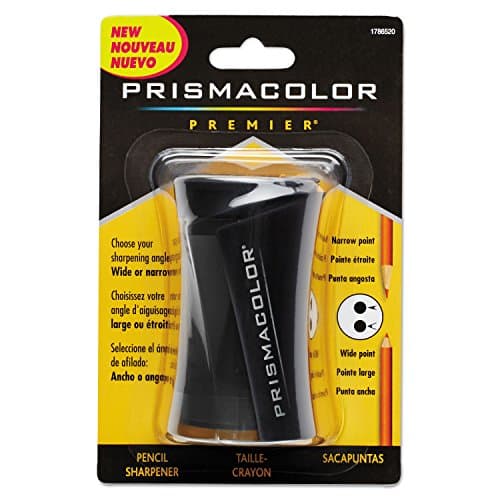
Prismacolor Premier Pencil Sharpener - Writing, Drawing, Sketching, Art Supplies
Prismacolor
- Sharpens your Prismacolor colored pencils to a perfect point
- Two different blades, both made from high-quality sharpened steel
- Select a wide point for coverage or a fine point for sharp details
- Translucent black body allows you to see exactly when the sharpener is full
Quick Verdict
Pros
- Dual-blade system switches between wide and fine points for versatility
- Translucent body makes it easy to see when the chamber needs emptying
- Steel blades stay sharp longer than standard sharpeners
- Compact desktop size fits neatly on any art desk
- Specifically engineered for Prismacolor Premier colored pencils
Cons
- Chamber fills up faster than you'd expect during long sessions
- Not ideal for standard graphite pencils — the fine point blade wears them down quickly
- Plastic casing feels somewhat cheap despite the premium branding
- No wall-mount option if you prefer a fixed station
Quick Verdict
The Prismacolor pencil sharpener is a dedicated tool that does exactly what it says on the tin — it puts a clean, consistent point on your Prismacolor Premier colored pencils without the drama. The dual-blade system is genuinely useful once you get into a workflow, and the translucent body means you're never caught off guard by a full chamber mid-project. It's not cheap, and the plastic housing feels slightly underwhelming for the price, but the steel blades and the way they handle soft wax cores make it worth owning if you're serious about colored pencil work. I'd give it a solid 4.3 out of 5.
What Is the Prismacolor Premier Pencil Sharpener?
Let me paint the scene: it's a Sunday afternoon, I've got a half-finished botanical illustration in front of me, and my favorite Prismacolor pencil just went dull at the worst possible moment. I reach for a generic battery-powered sharpener I got in a three-pack last year, and it chomps the lead, leaves a crumbly tip, and makes a sound like a dying hedge trimmer. That was the day I decided to try the Prismacolor Premier Pencil Sharpener.
This is a desktop sharpener specifically designed for the Prismacolor Premier colored pencil line. It's a manual crank sharpener — no batteries, no USB charging, just the satisfying mechanical whir of a well-engineered blade eating through wood and wax. The body is translucent black plastic, which sounds like a gimmick until you've spent three hours on a detail and realize you've been sharpening with a full chamber. You can see the shavings building up in real time, which sounds gross but is actually incredibly practical.
Key Features
- Dual-blade system with dedicated wide-point and fine-point steel blades
- Side-mounted blade selector switch for quick transitions
- Translucent body so you can monitor the shavings chamber at a glance
- High-carbon steel blades designed for soft wax-based colored pencil cores
- Compact desktop form factor, sits flat on any work surface
- Specifically calibrated for Prismacolor Premier pencil dimensions
Hands-On Review
First thing I noticed when I unboxed it: it's heavier than it looks. The weight comes from the steel internal mechanism, and that actually matters — a light sharpener skids across your desk when you crank. This one stays put. The translucent black body has a matte texture that feels grippy, and the crank knob is sized for fingers, not afterthoughts.
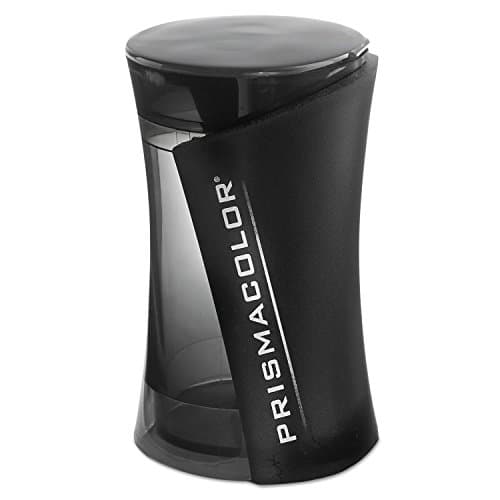
I spent the first week using almost exclusively the fine-point blade. My botanical work involves a lot of fine lines and gradient work, so a needle-sharp tip is non-negotiable. The fine blade on this sharpener consistently produced a tip I could write with — not quite needle-thin, but sharp enough for detail work without the core snapping under pressure. What surprised me was how cleanly it sheared the wood. No tearing, no splitting, just a clean spiral.
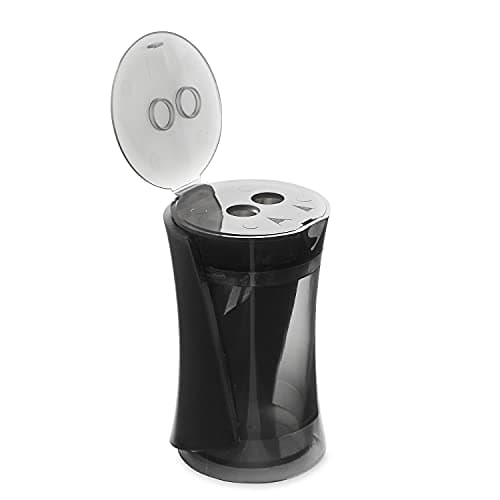
After about two weeks, I started experimenting with the wide-point blade for background fills. Here's where the dual-blade system actually earns its keep. Instead of a separate wide-format sharpener taking up desk space, you flip a switch and you're ready to lay down broad strokes. The wide point is less aggressive than I expected — it still produces a usable tip, just broader. I wouldn't use it for fine detail, obviously, but for building up color in layers, it saved me from switching between pencils constantly.
The shavings chamber is where I have a minor gripe. Colored pencil shavings, because of the wax and pigment binding, don't fall as freely as wood shavings from a graphite pencil. They tend to compact and cling. By the end of a four-hour session, the chamber was about half full — which the translucent body warned me about, fair enough. But emptying it requires a firm tap against a trash can and sometimes a little coaxing with a craft stick. It's not a dealbreaker, but it's the one moment in the sharpening process that feels less refined than the rest.
Who Should Buy It?
This is for you if you're deep into colored pencil art and you're tired of sharpeners that crush your soft cores into powder. If you work with Prismacolor Premier pencils regularly — whether that's illustration, adult coloring books, or botanical and wildlife work — this sharpener will pay for itself in saved pencils within a month.
It's also worth considering if you've upgraded from student-grade to artist-grade pencils and noticed your old sharpeners can't handle the softer cores. The steel blades here are calibrated for that wax softness, so you'll get clean points instead of crumbling tips.
Skip this if you mostly work with graphite pencils or use colored pencils only occasionally. A dedicated Prismacolor sharpener is overkill if you're not reaching for it daily, and a decent general sharpener will serve you fine. Also, if you're put off by plastic housings at this price point, you might be happier with a metal desktop sharpener from a brand like Kum — the Prismacolor excels where it matters (the blades), not the casing.
Alternatives Worth Considering
If the Prismacolor Premier Pencil Sharpener feels too niche for your setup, here are a couple of alternatives:
Kum Master Long Point Sharpener — A German-made long-point sharpener that works beautifully with artist-grade colored pencils. It produces an exceptionally long, tapered point ideal for fine detail, and the metal body feels more substantial. It's slightly more expensive but often lasts longer.
Prismacolor ArtistiCOLOR Electric Sharpener — If you prefer speed over the meditative crank, this battery-powered option handles Prismacolor pencils well. It's louder and the points aren't quite as surgical as the manual, but for large projects where you're sharpening every few minutes, it saves hand fatigue.
FAQ
It's optimised for Prismacolor Premier colored pencils, but it works with most pencil sizes. That said, the fine-point blade can be too aggressive for thin graphite pencils — use a standard sharpener for those.
Final Verdict
The Prismacolor Premier Pencil Sharpener won't win any beauty contests for its plastic housing, and the shavings chamber could be easier to empty. But when it comes to the one job that matters — putting a clean, usable point on your Prismacolor Premier pencils without destroying the core — it delivers consistently, day after day. The dual-blade system is genuinely thoughtful, and the translucent body is a feature I didn't think I'd appreciate as much as I do. If you're serious about colored pencil work, this sharpener belongs on your desk.