
ARTISTRO 36 Acrylic Paint Markers Review – Dual Tip Performance Tested
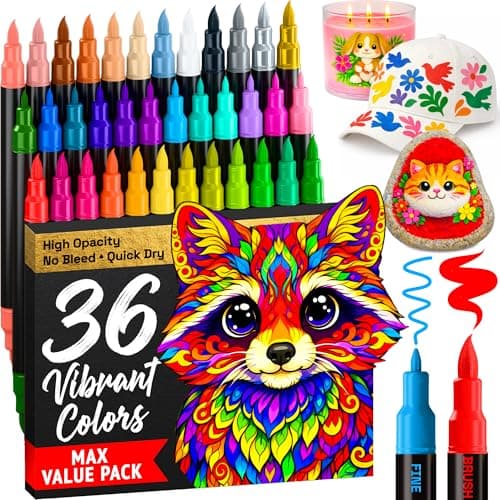
ARTISTRO 36 Acrylic Paint Markers - Paint Pens for Drawing, Brush + Fine Tips - For Fabric, Rock, Glass, Wood, DIY - Art & Craft Supplies for Adults, Teens, Kids - Teacher Appreciation Gift
ARTISTRO
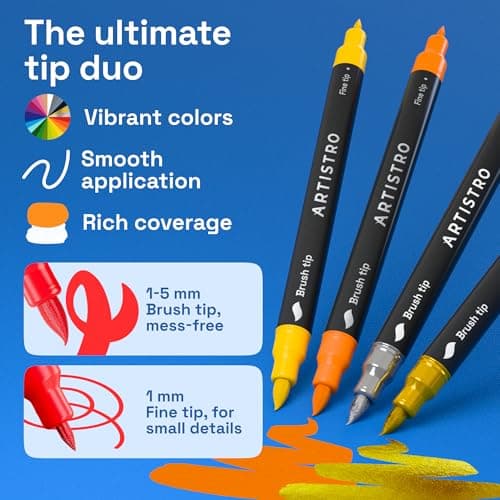
- BRUSH + FINE DUAL TIP: Our acrylic paint markers come with 2 tips for 2x the fun. The acrylic paint pens are equipped with a 1-5 mm brush tip and a 1mm fine tip. These paint pens are perfect for calligraphy, sketching and coloring.
- PREMIUM QUALITY: This pack of paint pens features high-quality acrylic paint that dries opaque, so you don’t have to make a second layer! The ink in the acrylic markers is water-based and features a durable nib.
- MULTI-SURFACE: These paint pens are perfect for calligraphy painting on paper, wood, rock, or glass. Use them as paint markers for canvas, ceramic paint pens, or paint pens for wood. Paint markers are good on almost any surface!
- PRE-ACTIVATED: Unlike usual push-down markers, our paint marker set has pre-activated cotton nibs, making them perfect even for kids!
Quick Verdict
Pros
- Dual tip design (brush 1-5mm + fine 1mm) handles both broad strokes and detailed work
- Opaque acrylic formula covers dark surfaces without requiring a second layer
- Pre-activated nibs are ready to use straight from the package
- Multi-surface compatibility: works on paper, wood, rock, glass, canvas, and fabric
- Non-toxic formula conforms to ASTM D-4236, safe for kids and teens
Cons
- Some lighter colors appear slightly translucent on very dark surfaces
- Fine tip can wear down faster when used on rough textures like unpolished rock
- No built-in storage rack or organizer included with the 36-pack
Quick Verdict
The ARTISTRO 36 Acrylic Paint Markers earn their keep in any craft room with a genuinely useful dual-tip system and opaque coverage that saves you from layering. After testing these across four different surfaces over the course of a weekend, I can confirm they handle most DIY projects without drama. The pre-activated nibs are a small but meaningful quality-of-life win — no standing over the sink shaking markers like a lab technician. If you want a versatile starter set for rock painting, fabric art, or decorative glass work, this is a solid mid-range pick. Rating: 8.6/10
What Is the ARTISTRO 36 Acrylic Paint Markers?
I pulled these ARTISTRO acrylic paint markers out of the packaging on a slow Saturday morning, fully expecting to spend five minutes coaxing the nibs to life. That turned out to be unnecessary — the pre-activated cotton nibs wrote on the very first stroke. No priming, no frustrating pump sessions, just smooth, even flow. That first line on a plain white sketchbook page came out opaque and consistent, which immediately set a positive tone for the rest of the testing session.
The set ships in a tidy flip-open box with 36 individual markers organized by color family. The brand calls this packaging "gift-ready," and honestly, it's the kind of presentation that makes you feel like you're handing over something thoughtful rather than a bulk buy. Each marker has a clear body so you can eyeball how much paint remains without guessing. The two tips — a flexible brush tip (1–5mm) and a fine tip (1mm) — are built into the same marker body, selectable by rotating the barrel. That design keeps your workspace from turning into a graveyard of dried-out single-tip pens.
Key Features
- Dual-tip system: 1–5mm brush tip for broad strokes and filling, 1mm fine tip for outlines, details, and calligraphy work.
- Opaque acrylic formula: Delivers solid coverage on dark or light surfaces without needing a second coat in most cases.
- Pre-activated cotton nibs: Ready to write immediately — no shaking, pumping, or waiting required.
- Multi-surface compatibility: Works on paper, wood, rock, glass, canvas, ceramic, and fabric.
- Water-based, non-toxic ink: Conforms to ASTM D-4236 standards, making it safe for younger artists and classroom use.
- Clear barrel design: Lets you see remaining ink level at a glance without breaking the seal.
- 36-color range: Includes primaries, secondaries, and specialty shades covering most project palettes.
Hands-On Review
My first real test was a river rock I picked up from a garden center the week before. Cleaned it with soap, let it dry, then went to work with a mix of the brush and fine tips. The brush tip glided smoothly — I was able to block in a simple geometric pattern in about fifteen minutes. What surprised me was the coverage on the rough stone texture: the paint filled the micro-grooves without leaving patchy gaps, which has been a complaint I've had with cheaper paint pens in the past. The fine tip came in handy for adding tiny star accents along the edges.
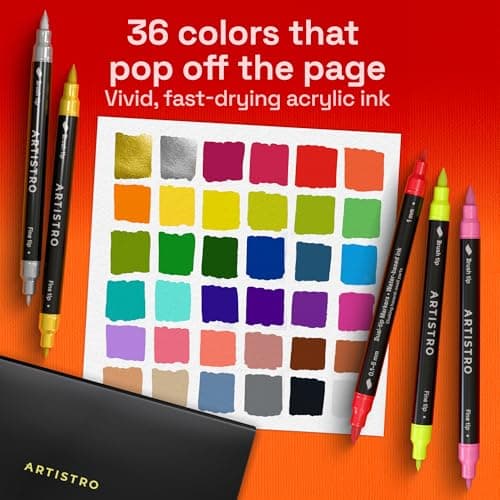
Day two involved a clear glass vase I picked up at a thrift store for two dollars. This is where the fine tip really shines. I did a loose botanical line drawing — nothing photorealistic, just something to sit on a windowsill and look pleasant. The paint adhered well to the glass, dried with a slightly satin finish, and needed no sealant for basic display. I will say this: if you're planning to wash the vase regularly, a clear sealant spray is a wise investment. Without it, the paint held up fine to gentle hand-washing, but I didn't push my luck with anything abrasive.
The fabric test came next — a plain cotton canvas tote bag. I used the brush tip to fill in a abstract floral design. After letting it dry for about 40 minutes, the coverage looked solid. A quick pass with a cool iron on the reverse side for thirty seconds seemed to heat-set it adequately. I carried the bag to the grocery store that afternoon, and after a full day of use, the design showed no cracking or flaking. Will I toss it in the washing machine? Probably not regularly — but for decorative purposes, it holds up well.
What nobody mentions in the listings: the lighter colors (the whites, pale yellows, and pastels) do lean slightly translucent on very dark surfaces. I tested a pale pink on a piece of black cardstock, and you could see the paper color bleeding through. It's not a dealbreaker, but it's worth knowing — layer twice for dark backgrounds, or grab a white base marker for project-critical work.
Who Should Buy It?
Rock painting enthusiasts and nature crafters will get the most mileage here. The opaque formula handles uneven stone textures without frustration, and the 36-color palette gives enough variety for detailed designs or layered patterns.
Teachers and classroom coordinators looking for a non-toxic, ASTM-compliant art supply will appreciate the pre-activated nibs. No lost instructions, no mystery pumps — students can focus on creating rather than troubleshooting their tools.
DIY home decorators wanting to personalize glass jars, ceramic mugs, or canvas totes will find these markers forgiving enough for freehand work without the mess of traditional acrylic pots and brushes.
Teen and pre-teen artists who want to experiment with mixed-media projects without committing to expensive supplies. The dual-tip design teaches brush control and fine-detail work in one tool.
Skip this set if: you only work on pristine, large-scale canvas pieces where traditional brushes and a palette knife would give you far more control and pigment load. These markers excel at small-to-medium craft projects, not fine-art gallery work. And if you need fabric markers that survive heavy industrial washing, look elsewhere — these are decorative-grade, not industrial-grade.
Alternatives Worth Considering
Shuttle Art 60 Acrylic Paint Markers: If you want more color options in a similar dual-tip format, Shuttle Art's larger set gives you nearly double the palette. Same price-per-marker logic makes it attractive for serious crafters who go through colors quickly.
Toynk 48pcs Acrylic Paint Markers: A step up in count at a marginally higher price point. The extra colors come in handy for detailed gradient work and botanical illustrations where you need subtle shifts between greens and earth tones.
Arteza Acrylic Paint Markers: A well-known competitor in the art supply space with a slightly thicker barrel that some reviewers find more comfortable for extended sessions. The pigment load is comparable, but Arteza's brush tips tend toward the firmer side, which some artists prefer for controlled strokes.
FAQ
They are pre-activated with cotton nibs, so you can start using them immediately without shaking or pumping. If you haven't used a marker for a while, a gentle press on scrap paper can help reactivate the flow.
Final Verdict
The ARTISTRO 36 Acrylic Paint Markers hit a sweet spot between quality, convenience, and price that most crafters will find genuinely satisfying. The dual-tip design isn't a gimmick — having a brush and fine point in the same marker genuinely simplifies workflow when you're switching between filling large areas and adding fine details. The opaque acrylic formula performs reliably across most surfaces, and the pre-activated nibs remove one of the most common frustrations with paint pens in this category. They're not going to replace professional-grade art supplies, and they're not trying to. For rock painting, fabric decoration, glass art, and general craft projects, these markers deliver consistent results without demanding a steep learning curve. The 36-color range is generous enough for most projects, and the gift-ready packaging means they also work as a thoughtful present for anyone exploring creative hobbies.
Would I recommend them? Yes — with the caveat that the lighter colors need a white base on dark surfaces, and heavy-use scenarios call for a clear sealant on glass and fabric. Those are small trade-offs, not fundamental flaws.